
Author: VIPICO Technical Team
The price of a scanning laser vibrometer should be evaluated for the complete measurement system: the optical sensor, scanning mechanism, geometry registration, synchronized data acquisition, analysis software and commissioning. Two quotations can contain different capabilities even when both describe a scanning laser vibrometer. Start with the engineering result you need, then compare quotations against the same test specification.
This guide covers automated multipoint structural vibration measurement and modal testing. It does not treat a single-point laser sensor, a two-dimensional scan grid and a three-component vibration system as interchangeable products.
What a scanning system quotation should include
The detector measures vibration along its optical line of sight. Scanning adds controlled positioning and associates each response with a location on the structure. To obtain a meaningful mode shape, the system also needs a suitable acquisition and analysis workflow.
Ask suppliers to separate the following items. An inexpensive optical head can become a more expensive project if essential acquisition hardware or analysis licences are excluded.
| Quotation item | What to specify | Why it affects cost |
|---|---|---|
| Laser measurement head | Required bandwidth, amplitude range, signal output and optical conditions | Decoder and lens configurations address different tests |
| Scanning and positioning | Test area, distance, target angles and repeatable point placement | Coverage and positioning must match the structure |
| Geometry registration | Scan grid, coordinate export and any vision-assisted alignment | Registered coordinates connect data to the specimen |
| Acquisition and reference | Response channels, force or reference channels and synchronization | Modal analysis needs a valid input and response relationship |
| Analysis software | Required ODS, EMA or OMA functions, licences and export | An animation does not necessarily include modal identification |
| Test accessories | Excitation equipment, supports, fixtures, computer and cables | Items may be included, optional or supplied by the laboratory |
| Delivery and support | Installation, training, calibration, warranty, shipping and taxes | Totals depend on delivery destination and service scope |
Request an itemized quotation with included items, options and exclusions. Compare the delivered system price rather than only the sensor line item.
A public procurement example
The University of Salford published a scanning laser vibrometer contract award on 26 March 2024. The notice records a contract value of GBP 122,883 excluding VAT, alongside an initial estimated value of GBP 205,000. These figures have different roles: an initial estimate and an awarded contract amount. Source: UK Find a Tender contract award notice.
The public summary does not establish a universal instrument configuration or a current market price. It cannot serve as a price range for all scanning systems or as a quotation for another supplier. It demonstrates why an estimated budget and a final contract amount should be labelled separately.
Retain the currency, date, tax basis and scope when using a public procurement example. Obtain a current written quotation for your configuration and delivery destination.
Specify the measurement dimension first
A 2D scanning laser vibrometer normally describes points arranged over a surface. Each point can still contain only one vibration component along the laser beam. A camera can provide geometry, but geometry alone does not recover all three components of motion.
If the test requires three-component vibration, specify the optical measurement directions, coordinate transformation and synchronization needed to recover those components. A one-component quotation should not be compared directly with a three-component quotation.
If one response location is sufficient, consider a single-point configuration. The single-point versus scanning comparison explains the difference, while the 2D scanning guide describes surface-grid measurement.
Engineering example from blade comparison testing
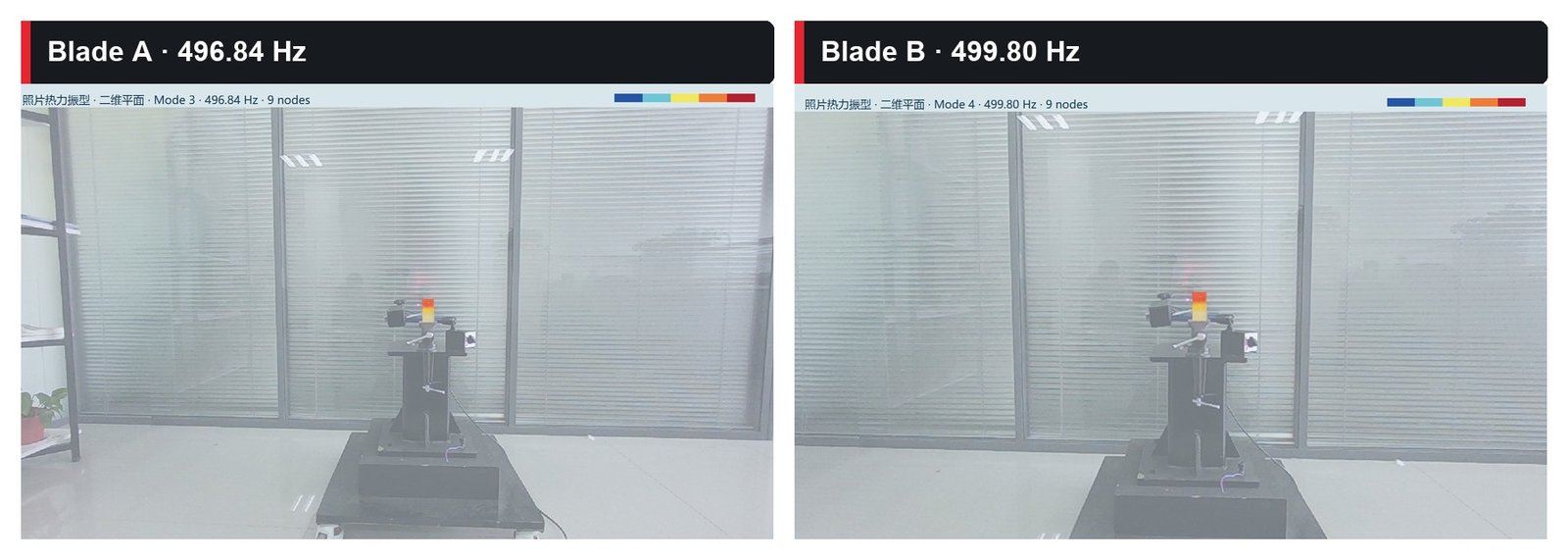
VIPICO's published Blade A and Blade B comparison uses a supplied dataset with nine corresponding response locations and H1 frequency response functions over 70–3000 Hz. The analysis compares identified frequencies, damping and spatial mode correspondence. The low-frequency pair is reported at 496.63 Hz for Blade A and 499.42 Hz for Blade B, with a complex modal assurance criterion, or MAC, of 0.993. Read the blade comparison case.
This example explains a budget decision. Screening a resonance at one accessible position may require only a local response measurement. Comparing mode identity between blades requires consistent coordinates, reference data and spatial responses. The published case does not establish that nine points suffice for every blade, and frequency shifts alone do not identify a particular defect.
Translate that distinction into the purchase specification. Ask for a demonstration of repeatable point registration, suitable reference or measured input, rejected-point handling and export of the data needed for your comparison. These functions determine whether the delivered system can produce the requested evidence.
Gimbal scanning and structural test throughput
A gimbal scanning arrangement directs the measurement head toward planned locations. For structures occupying a wide angular field or requiring stand-off access, this can simplify coverage from a suitable observation position. Suitability depends on clear optical access, mounting stability, focus, surface return and required point spacing.
In sequential modal testing, acquisition time includes positioning, settling, record duration, averaging and repeated measurements. Maximum steering speed alone is therefore a poor estimate of throughput. Request an end-to-end demonstration with a representative grid and acquisition settings.
For the PVM-100 scanning laser vibrometer, the quotation should identify the delivered measurement-head configuration, gimbal and geometry workflow, acquisition hardware and enabled analysis functions. Confirm which options are included. Validate usable distance and angular coverage on a representative specimen rather than purchasing on a maximum-distance figure alone.
Build the budget around an acceptance test
A useful budget has a defined scope before it has a number. A laboratory blade test may require a repeatable fixture, optical response measurement, synchronized force or reference acquisition, a registered grid and mode-shape comparison. An operating-structure test may need a different acquisition and reference arrangement.
Your request for quotation should state:
- Specimen type, dimensions, accessible surfaces and mounting conditions.
- Target frequency band, expected vibration amplitude and smallest response of interest.
- Working-distance range and optical access at difficult points.
- Required vibration component and approximate grid spacing or point count.
- Excitation method and available force or reference channels.
- Required outputs, such as spectra, FRFs, ODS or identified modal parameters.
- Representative acceptance test, repeatability criteria and deliverable formats.
- Delivery country, calibration, training and service expectations.
Ask for a base configuration and separately priced options. This makes expansion costs visible without obscuring the cost of the first usable system.
Frequently asked questions
How much does a scanning laser vibrometer cost
There is no single defensible price for all scanning laser vibrometers. Cost depends on optics, measurement dimension, positioning, acquisition channels, software and delivery scope. A public award is a historical example; a current itemized quotation is the appropriate purchase basis.
Is a 2D scanning system cheaper than a 3D vibration system
They can have different hardware and analysis requirements, but prices must be checked against actual configurations. A 2D point grid does not automatically measure three vibration components. Compare systems that deliver the same required output.
Does a higher scan point count require a more expensive laser head
Not necessarily. Point count primarily affects positioning, acquisition time, data handling and analysis. Bandwidth, signal quality, amplitude range and optical access may have a greater effect on the measurement-head configuration.
Should modal analysis software be included in the price
It should be explicitly included if identified frequencies, damping and mode shapes are required. Confirm supported methods, reference-channel requirements, licence terms and export formats. ODS visualization alone is not a complete modal identification package.
Can a public procurement price replace a supplier quotation
No. Its date, configuration, service scope and tax basis belong to that procurement. Use it as a documented comparison point, not a current list price or guaranteed price for another system.
Request a configuration matched to your structure
Send test-object dimensions, target frequency band, working distance and required outputs through the VIPICO contact page or to sales@vipico-tech.com. A configuration review can distinguish essential measurement functions from optional expansion before a formal quotation is prepared.