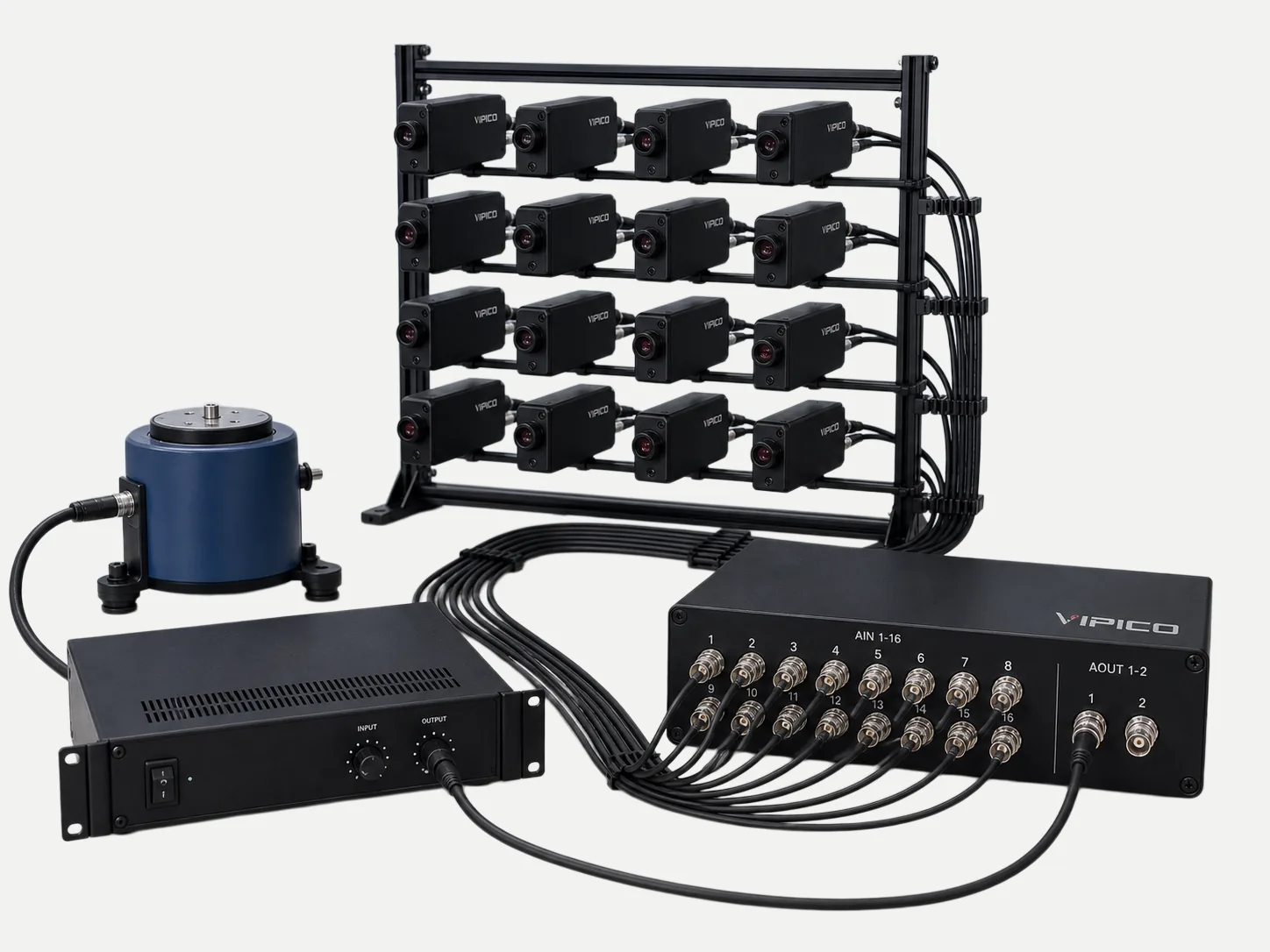
SYNCHRONOUS PRECISION VIBROMETRY ยท VP-PRECISION S3
Multi-Channel Synchronous Laser Vibrometer
Synchronized non-contact vibration measurement for precision components, micro-vibration and phase-consistent multi-point testing.
Capabilities and Intended Tasks
The following information supports preliminary system discussions. Final performance and interfaces depend on the selected configuration and technical agreement.
Multi-channel synchronized measurement
Captures multiple measurement or reference channels on a common time base.
Non-stationary excitation support
Suitable for tasks where the operating or excitation condition changes over time.
ODS, OMA and EMA workflows
Supports operating deformation and operational or experimental modal analysis.
Visualization and engineering output
Organizes synchronized data for interpretation, comparison and reporting.
Typical Applications
- Vibration source localization
- Non-stationary ODS and modal analysis
- Multi-point industrial equipment monitoring
Public Configuration Information
| Configuration item | Current public information | Notes |
|---|---|---|
| Model | VP-PRECISION S3 | Current published model. |
| Product type | Multi-channel synchronous laser vibrometer | For synchronized multi-point or multi-direction response acquisition. |
| Measurement method | Non-contact laser vibration measurement | For objects where attached sensors are undesirable. |
| Channel characteristic | Multi-channel synchronization | The channel combination is configured for the project. |
| Analysis capability | ODS, OMA and EMA | Functions depend on the delivered software version. |
| Typical tasks | Source localization, non-stationary modal testing and industrial multi-point monitoring | Reference channels and synchronization must be designed for the test. |
| Numerical specifications | Defined by formal technical documentation or project agreement | No unpublished numerical values are introduced on this page. |

This table summarizes information currently published by VIPICO for preliminary selection. Numerical range, bandwidth, working distance, channel count, accuracy and interfaces are governed by the final technical documentation or agreed project specification.
Define the object, distance, frequency range and required output.
Combine with Research & Laboratory Testing or Industrial Equipment to define the synchronization and reference-channel strategy. See Technology and Resources.