
Technical review: Mr. Sun, Technical Manager
Summary: ODS, OMA and EMA answer different structural-dynamics questions. ODS visualizes how a structure moves at a selected operating frequency; OMA estimates modal properties from output-only operational data; EMA uses measured input and response to identify modal parameters from frequency-response functions.
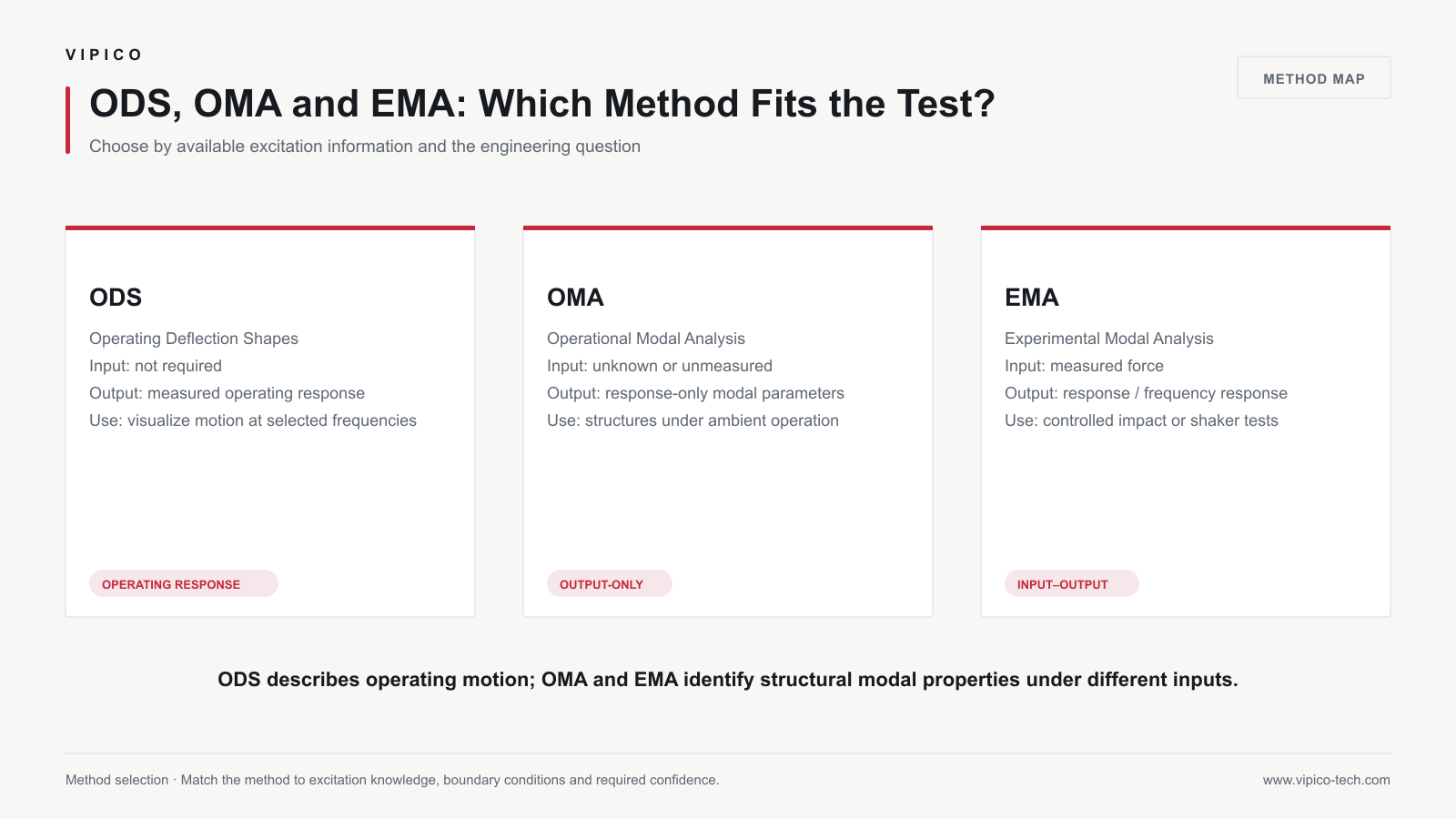
Core Definitions
Operating Deflection Shape (ODS)
ODS represents the relative motion of measured points at a chosen frequency or operating order. It describes the combined effect of structural dynamics and the actual excitation. It is not automatically a mode shape.
Operational Modal Analysis (OMA)
OMA identifies modal frequencies, damping and mode shapes from response-only data. The excitation is not directly measured and is commonly treated as broadband or stochastic within the assumptions of the selected method.
Experimental Modal Analysis (EMA)
EMA uses known, measured excitation—typically an impact hammer or shaker—and measured responses to calculate frequency-response functions and identify modal parameters.
Method Comparison
| Criterion | ODS | OMA | EMA |
|---|---|---|---|
| Measured input required | No, but a phase reference is often useful | No | Yes |
| Main output | Deformation pattern at a selected frequency/order | Modal frequency, damping and mode shape | FRFs and modal parameters |
| Operating state | Normal operation | Normal or ambient operation | Controlled test condition |
| Excitation assumption | No modal assumption required for visualization | Method-dependent output-only assumptions | Input is measured and controlled |
| Typical question | Where and how is the structure moving now? | What are the modes under operating conditions? | What is the input-output dynamic model? |
When to Use ODS
Use ODS to locate strong motion, compare operating orders, visualize resonance-like behavior and communicate spatial response. It is effective for troubleshooting, but a deformation pattern should not be labeled a mode without modal identification evidence.
When to Use OMA
Use OMA when controlled excitation is unavailable or undesirable, such as large civil structures, rotating equipment under operation or systems that cannot be removed from service. Ensure the excitation and stationarity assumptions are reasonable and document changes in operating condition.
When to Use EMA
Use EMA when FRFs, measured force, controlled boundary conditions and repeatable modal parameters are required. EMA is well suited to design validation, finite-element correlation and component-level structural characterization.
Common Interpretation Risks
- Treating every ODS peak as a structural mode
- Applying OMA when deterministic harmonics dominate without appropriate processing
- Ignoring input-force quality, double hits or poor coherence in EMA
- Comparing results from different boundary or operating conditions
- Reporting damping without the estimator, bandwidth and confidence information
Frequently Asked Questions
Can one measurement campaign produce ODS and modal results?
Yes, if the acquisition includes appropriate phase, reference and input information. The measurement design should anticipate the analyses before data collection.
Which method is best for rotating machinery?
ODS is useful for operating-order visualization; OMA can identify modes under suitable output-only conditions; EMA may be used when the machine can be tested with controlled excitation. Often a combination is most informative.
Is OMA always output-only?
Classical OMA is output-only. Operational modal analysis variants and hybrid workflows may use additional references, but the method and assumptions should be stated clearly.
Related Products and Resources
- Gimbal Scanning Laser Vibrometer
- Laser Vibrometry Technology
- Application Solutions
- Contact VIPICO Engineering