
Technical review: Mr. Sun, Technical Manager
Summary: A laser Doppler vibrometer (LDV) measures motion by detecting the frequency or phase change of light reflected from a moving surface. It enables non-contact vibration measurement and avoids the mass loading introduced by attached sensors.
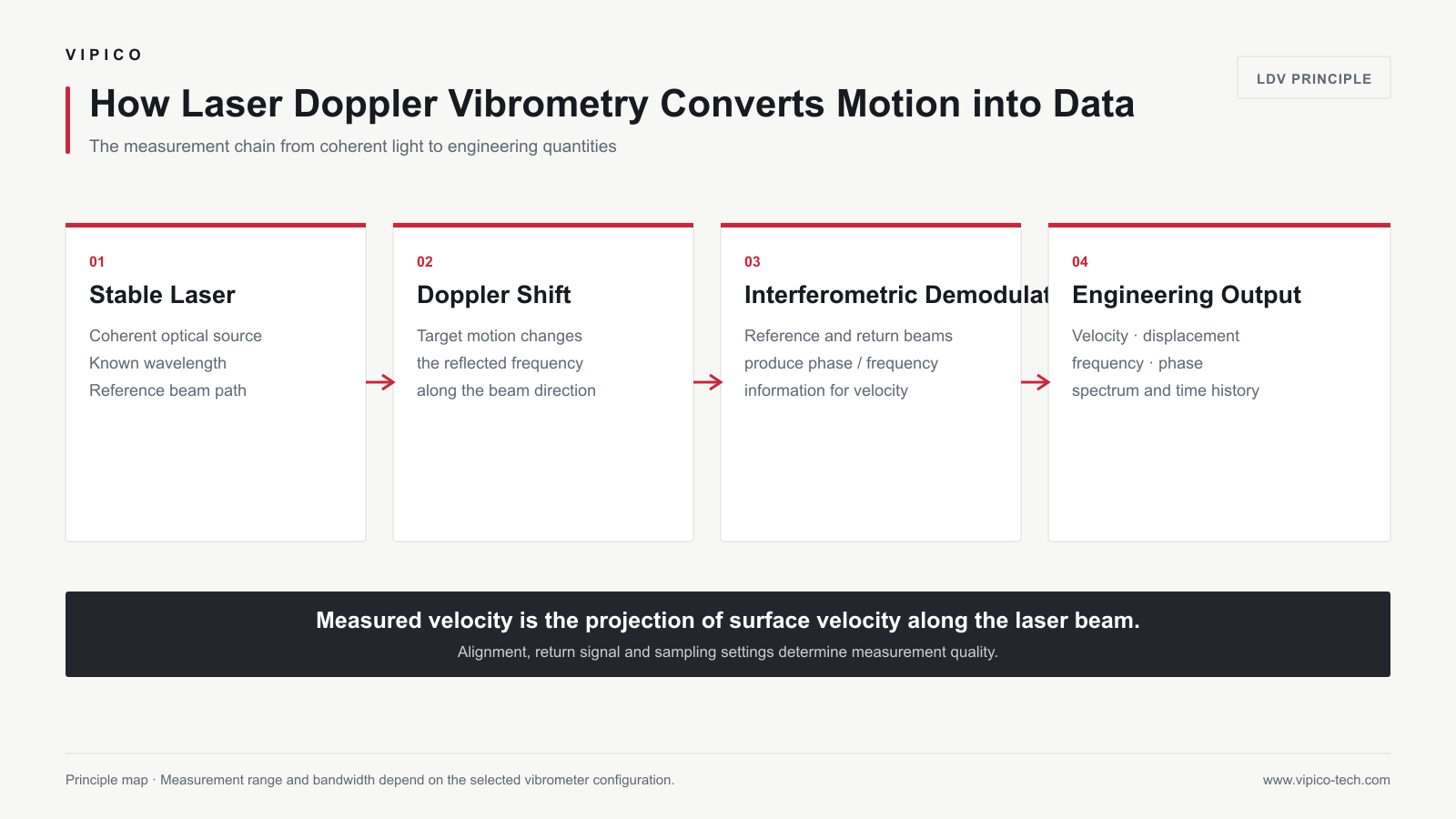
The Doppler Principle
When light is reflected from a surface moving along the beam direction, its frequency changes. For a backscattering geometry, the Doppler frequency is commonly represented as fD = 2v cos(θ) / λ, where v is surface velocity, θ is the angle between motion and the optical axis, and λ is the laser wavelength.
The instrument therefore measures the velocity component along the beam. If motion is not aligned with the optical axis, the cosine term must be considered when interpreting the result.
From Reflected Light to Vibration Data
- A coherent laser beam is directed at the target.
- Reflected light carries a phase or frequency change caused by surface motion.
- An interferometric receiver compares the measurement beam with a reference beam.
- A photodetector converts the optical interference signal to an electrical signal.
- Demodulation produces velocity; displacement or acceleration can be derived within appropriate bandwidth and noise limits.
What an LDV Can Measure
| Quantity | How it is obtained | Important consideration |
|---|---|---|
| Velocity | Directly from Doppler or phase demodulation | Primary LDV output in many systems |
| Displacement | Integration of velocity or phase-based processing | Low-frequency drift and integration limits must be controlled |
| Acceleration | Differentiation of velocity | High-frequency noise can be amplified |
| Frequency and phase | Spectral or transfer-function analysis | Reference synchronization may be required |
Surface, Angle and Distance
Measurement quality depends on sufficient optical return. Surface roughness, reflectivity, curvature, incidence angle and atmospheric path all affect signal level. Retroreflective tape can improve return but should be used carefully on lightweight structures because even small added mass or local stiffness changes may matter.
Typical Applications
- Modal testing of lightweight or delicate structures
- MEMS and miniature components
- Rotating, hot or inaccessible targets
- Automotive NVH and aerospace structures
- Ultrasonic transducers and high-frequency vibration
- Material damping and natural-frequency measurements
- Operating deflection shape visualization
Frequently Asked Questions
Does an LDV measure total three-dimensional motion?
A single optical channel measures the component along its beam. Three-dimensional motion requires multiple measurement directions or a dedicated 3D system.
Is surface preparation always required?
No. Many surfaces provide adequate return. Preparation is considered when signal quality is insufficient or inconsistent across the target.
Can an LDV replace accelerometers?
It can replace attached sensors in many applications, but the correct choice depends on bandwidth, line of sight, reference requirements, environmental conditions and the required measurand.
Related Products and Resources
- Gimbal Scanning Laser Vibrometer
- Laser Vibrometry Technology
- Application Solutions
- Contact VIPICO Engineering