
Technical review: Mr. Sun, Technical Manager
Summary: Gimbal and galvanometer scanners both automate laser-vibration measurements, but they optimize different constraints. Galvanometer mirrors are typically fast within a limited angular field; a precision gimbal can provide wider angular coverage and is often better suited to large or remote targets.
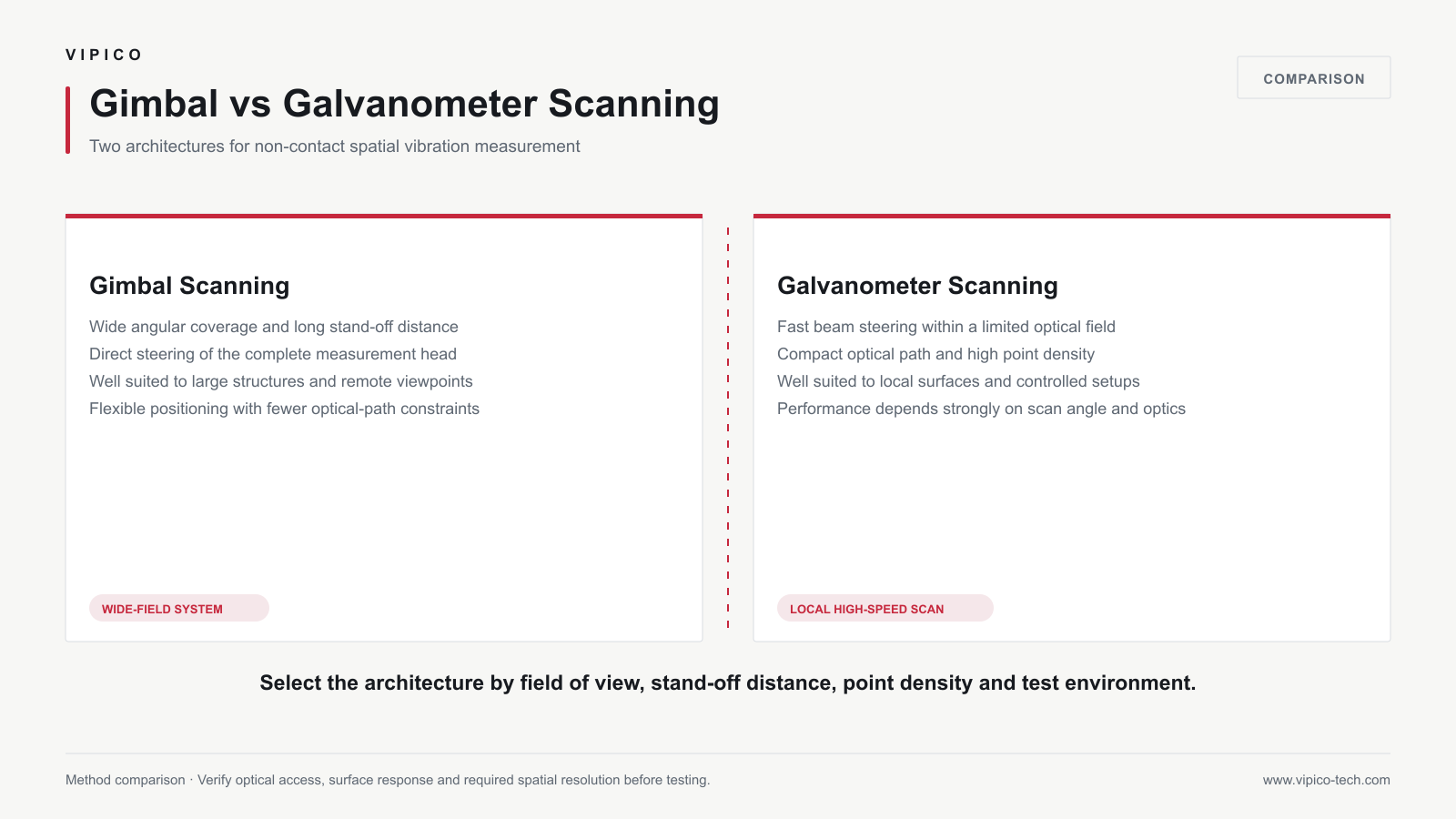
How the Two Scanning Mechanisms Differ
A galvanometer scanner changes beam direction with small, fast mirrors. A gimbal scanner rotates the optical measurement head or beam-steering assembly around controlled axes. The mechanism affects angular range, point-to-point speed, optical path, calibration strategy and the type of structure that can be covered from one setup.
Engineering Comparison
| Criterion | Gimbal scanning | Galvanometer scanning |
|---|---|---|
| Angular coverage | Generally suited to wider pointing ranges | Usually optimized for a smaller optical field |
| Point-to-point speed | Moderate; affected by mechanical settling | Typically faster for compact scan patterns |
| Large-target coverage | Strong advantage for wide or remote structures | May require repositioning or additional optical arrangements |
| Stand-off distance | Well suited to long-distance layouts when optical return is sufficient | Can support remote work but field coverage narrows with angular limits |
| Calibration | Requires accurate pointing, coordinate registration and settling checks | Requires mirror-angle and optical-field calibration |
| Best-fit task | Large structures, curved surfaces, wide fields, flexible deployment | High-speed scans over compact areas and controlled laboratory geometry |
Advantages of Gimbal Scanning
- Broader pointing range for large structures
- Flexible stand-off distance and deployment geometry
- Easier adaptation to objects with widely separated regions of interest
- Reduced need to move the entire instrument between scan zones
- A natural fit for task-specific automated point planning
Trade-Offs That Must Be Managed
A gimbal is not automatically better for every test. Mechanical motion and settling can increase cycle time. Coordinate registration, backlash control, pointing repeatability and line-of-sight checks are important. For very dense, small-field, high-speed scans, a galvanometer system may remain the more efficient choice.
Selection Guide
| If the priority is… | Usually consider… |
|---|---|
| Very fast scanning over a compact field | Galvanometer scanning |
| Wide angular coverage or a large structure | Gimbal scanning |
| Long stand-off distance with separated areas of interest | Gimbal scanning |
| Controlled laboratory target with a small scan window | Either; compare speed, precision and integration needs |
| Modal testing with a reusable large point grid | Often gimbal scanning, subject to reference-channel and timing requirements |
Frequently Asked Questions
Is scanning speed the only selection criterion?
No. Field of view, target size, distance, surface return, point repeatability, phase requirements and analysis outputs can be more important than raw scan speed.
Which method is better for modal testing?
Both can support modal work when acquisition and synchronization are appropriate. The target geometry and required spatial coverage usually determine the preferred scanner.
Does a wider field reduce measurement accuracy?
Not inherently, but wide-angle work increases the importance of coordinate calibration, incidence-angle review, optical return and geometric registration.
Related Products and Resources
- Gimbal Scanning Laser Vibrometer
- Laser Vibrometry Technology
- Application Solutions
- Contact VIPICO Engineering